

Cut the fluff and tell people who you are at first glance. Step-by-step, I’ll help you write a clear, concise brand statement + have a good idea of your customer’s motivations.
At least for me, I felt like before I did anything with any kind of business, I wanted a good understanding of what was going on.
It’s so overwhelming at first.
So much to define.
So much to decide.
But ideally, from the get go… You want know what you’re offering, to who you’re offering it to, and why you’re offering it, but you also want a good idea of why someone else would want it.
This brand statement method helps you answer all those questions. Coherently.
THEN you can take this information and use it to help improve consistency in your brand and content. In addition, you have a story concept to pull ideas for content and a manner that’s more sales friendly.
What is a Brand Statement?
A brand statement, basically, is a small clip of words that conveys exactly what you’re about and why you are awesome.
Name Cheap defines it as…
A brand statement is a concise summary of what your business does, how you do it, and what makes it unique. In just a few sentences (preferably one) people should be able to understand you or your company’s mission, goals, values, and how you or your business is different from your competition.
A well crafted brand statement exhibits some or all of the following:
- Who you are or What your Business Does
- Who you help
- Problem you Solve
- How you do it
- What makes you unique / Why are you different
It should also be
- Clear and obvious
- Conveyed in some way on every page on your site
- Match your Brand
- Sound Natural
It’s not your tagline, such as Nike’s Just Do It and Subway’s Eat Fresh. That’s more emotional. But some people intermix the two and it doesn’t really matter except for purposes of here, the brand statement is more about creating a short statement to answer questions like, “So what do you do?” It would be really weird if you answered that question with, “Oh. I eat fresh. Taste the rainbow. Finger Licking Good.”
The Purpose of the Brand Statement
This is another crazy business block you can add to almost anything like a business plan, an about me, etc.
The main purpose of the brand statement is to really make who you are and what you do so clear and obvious, nobody could screw it up.
The internet is just a high speed kind of place, and people bee bop around all willy nilly going down various rabbit holes and they really don’t want to spend any real time (like more than 3 seconds) or energy into deciding if you’re their next rabbit hole adventure or not.
Your first pitch is pretty much, “I do graphic design.” And then they decide, “Yeah, I need to look at this,” or “No, I already got a graphic designer,” or “No, what would I need a graphic designer for, I’m 12 years old.”
If you don’t have that. Then they are just going to be all, “I have no idea what this person does, what they are selling, I just don’t care anymore I’m going back to Facebook.”
The second purpose of the brand statement is to act as a clarity statement to help guide the rest of your copy and content management.
The idea of a “cohesive brand” is more than just make your colors and fonts match throughout. You really want a consistent voice as well.
The websites I’m most impressed by has the clearest message in ways I get a little jealous. Like I’m over here with my business idea, stressed out because I have too many things going on at once, and I don’t have that simple, clear message.
And it’s beyond the “Hello. Hi. I’m Blankety Blank McStuffins and I help people…”
Whatever is in that statement, it’s just super effective when you see that conveyed in the web design, in the category options, in the calls to action, in the products they are selling, the freebie they are offering, in the sales page copy. When all that is consistent, it’s just incredibly powerful. Not only is it harder to say no to, but the trust is really amplified.
If you can’t figure out your message clearly, the stress it makes you feel passes on to the user experiencing your website and business.
You can mix this up with all the other kinds of business statements – the vision statement, the mission statement, the value proposition, etc. by creating those with the same consistent story that matches your brand statement. But the heart of it all is your brand statement.
Step 1: Get your Story Straight
Your brand encompasses so much, you kind of want to get a good vibe for everything before delving into specifics like visual branding, voice, and more specifically, your brand statement.
This step might be very quick and easy for you to do because it was already done, somewhere in the back of your head, from the get go. Maybe you already wrote it out. That is awesome if you have.
But if you haven’t, it helps to really visualize the story of your customer’s journey as told through you and your experiences.
Think about…
- Who your target market is
- Go through their average day in your mind
- What is their idea of a bad day?
- How much of their day is spent on your niche?
- What niche-related problems do they face?
- What niche-related tasks do they have to do?
- What are their niche-related pain points?
- What are their niche-related motivations?
- What are their aspirations? Who do they aspire to be?
- What do they really want out of life?
- What social motivations are they facing (niche-related)?
- What do they wish their spouses or parents would say or do related to the niche?
- What are they already spending money on? Niche related.
- What are they wasting money on?
- What have they tried that did not work?
- What do they think is their next step?
- What is the best next step for them?
After you think about it, maybe write a list, then kind of craft the story.
It doesn’t have to be exact. Like we have absolutely no idea what Bob is really doing throughout the day. But say you know there are people out there who struggle with X. As you think about their journey, you kind of figure out where you play a role in it to help you know what emotions, motivations, pain points etc. to focus on what’s going to attract people who want your product.
Your customer feels this. Your customer has this problem. And you want to help them by… What will life look like for them after your help? Ideally and realistically.
Get a good idea of everything your customer faces in their journey through life.
So, say you are a food blogger who makes money from ads. You still want to think about who your target market is, maybe vegans, who aspire to live healthy and feel better, and you want to focus on how your recipes will help them live healthy and feel better.
But as that food blogger above, you want to think about their journey. What made them decide they wanted to eat healthier? What temptations do they face? You may discover things like, “My target market feels that meat is unhealthy for the body, and many love animals too much to eat them. They often also prefer water over soda, homeopathic health over pharmaceuticals, fresh + organic ingredients, and most live a very minimalist lifestyle. They often feel like family misunderstands them and their intentions, and they wish people could respect their choices.”
And now you have a great idea of your people, and you have good ideas for your vibe, your message, your design, your social media personality… as well as a ton of ideas for content on your blog as well as social media, and possibly some categories.
Step 2: Hone in on your message
You want to kind of narrow down all your thoughts with your target audience to what you do for them.
Focus on…
- What you enjoy doing the most
- What you do best
- What will resonate with people the best
Maybe everyone else is doing “eat healthier” recipes, and you feel like that doesn’t resonate anymore because it’s overplayed. So instead, you want to focus on “Feel Better.”
You can choose to focus on any of the following…
- Alleviating pain
- Solving a problem
- Leading them to the next level
- Motivating
- Helping achieve achievement
- Improving performance
- Anything you think people will pay for
But the main idea here is to decide how you help people.
Step 3: What makes you different?
How would you describe the differences between 3 Yoga Studios to your friend? Or 3 Spas? or 3 Pizzarias?
My friend Letitia with SelfMade Ladies asked me that question in one of her online trainings, and it still is the best question to ask yourself to figure out what makes you unique, and maybe better. Letitia is also one to help me craft that story above (though that’s just her step 1 to crafting amazing sales copy).
In fact, let’s use Letitia as an example. How would I explain how she stands out from all the other possible business mindset coaches you can find on the internet?
The thing I love about Letitia is that she’s definitely a sales person. I highly recommend her because if you’re like me, you’re going to spend too much time researching and learning about sales from the angle of SEO and Social Media, but real sales is a personality and mindset thing. A people thing. And it’s nice to get training and ideas from a real sales person who also has experience with internet sales.
So whatever it is you do, try to think about how your target market would describe the differences between you and 2 of your closest competitors to their friends.
Like Nas portrays stories about ghetto life through descriptive imagery while Tupac focused on the emotional stories that take place within the unnamed characters.
The important thing is to focus on what makes you different. It doesn’t necessarily have to be better.
Step 4: Put it Together
Put together these very basic ideas into one or two sentences.
- Who you help
- How you Help them
- What makes you different
- Maybe what or who you are…
So like …
Graphic Designer who helps small business owners create the website of their dreams.
I make people eat better and feel better with vegan recipes and homeopathic cooking.
Easy Vegan Recipes that help people eat better and feel better.
Real Examples:
“I am a fitness and nutrition coach who aims to help improve lives through exercise, healthy eating, and spiritual awareness.”
I don’t think that’s his branding statement, but it could be. It came from Career Sidekick’s description of what Adam does. His tagline is, ““Move well, eat well, think well.” You have no idea what he does with that tagline. But a great tagline nevertheless.
“I’m a publicity and marketing strategist who helps experts, authors, and coaches go from “hidden gem” to admired industry leader…and even a household name.“
The important part is to convey who you are and what you do, but it’s way better if you can also throw in some psychological component such as aspiration, or motivation.
Brand Statement Tips
If you are planning to plop this on your main page or About page, then you want to make sure your words are clear, concise, and easy to understand.
- Avoid passive tone
- So clear a 12 year old can understand
- Avoid big words
- Great SEO
- If you can, really tap in on a huge motivation for people to want your thing.
- Aim to make someone feel the feels without using emotional words
Wrapping it up
The brand statement is a great way to effectively convey your overall message and to give you clarity for other content and copy. It is your overall big picture of who you are, what you offer, and how you are different.
Use this Free Printable to help you craft your brand statement!
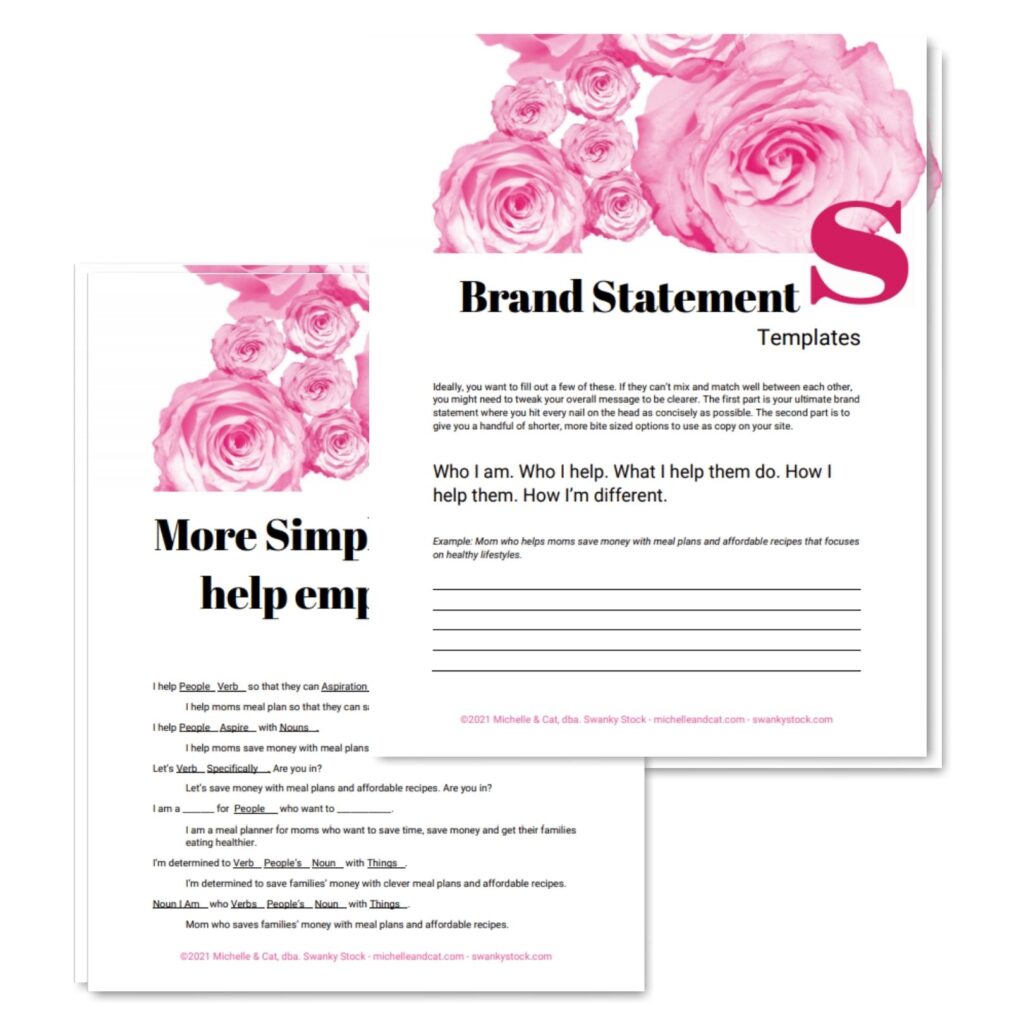
Ready to write this and get it done?
Think of all the clarity you will have moving forward once you do this.
Related Google Story

Pin it.

Interested in becoming a member?